
Where the money from Ocean Beer actually goes.
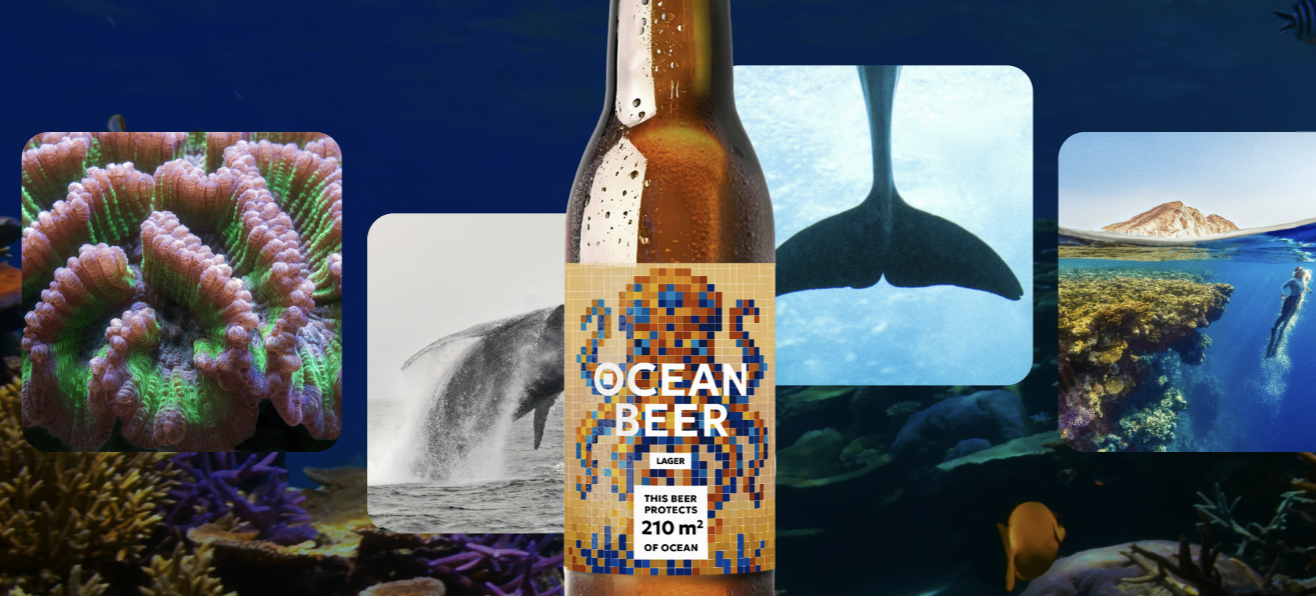
Every Ocean Beer sold contributes to a straightforward promise: 100% of the profits are donated to projects that restore ocean health. But what does that actually mean in practice? Where do the funds go, who selects the projects, and how do we know the impact is real?
These are all legitimate questions, and they deserve a proper answer.
A promise built into our ownership structure
The starting point is our ownership structure. The Ocean Beer brand is fully owned by Ocean Born Foundation, a certified non-profit organisation whose mission is to unlock new funding to protect our blue planet. This structure is what allows us to guarantee that 100% of the profits generated by the brand are directed back to ocean action, not as a discretionary donation but as a structural, non-negotiable commitment. Since we launched in 2021, this model has already channelled over €500,000 into high-impact, chronically underfunded marine restoration initiatives around the world.
A balance between global and local impact
Ocean Beer was born from a simple but bold idea: to turn every beer into real, measurable ocean action. So when deciding how to donate our profits, we don't just chase the trendiest or most glamorous projects – we focus on initiatives that deliver the most concrete impact on ocean health, balancing global projects where funds are most needed with local actions that create visible change on our shores. Concretely, half of the profit from every bottle sold supports large-scale Marine Protected Areas in some of the most biodiverse regions of the planet, and the other half stays in the country where the beer is brewed and enjoyed.
The global half: Marine Protected Areas with Blue Alliance
Marine Protected Areas (MPAs) are widely recognised by the scientific community as one of the most effective tools to restore ocean life, but their real-world impact depends entirely on whether protection is actively enforced on the water. Many MPAs exist only on paper: they are officially designated as protected zones, but destructive practices such as dynamite fishing, poison fishing, or bottom trawling continue inside them because of insufficient funding and weak enforcement. The result is that the ecosystems these areas are supposed to shelter never really get the chance to recover.
Within the MPAs we fund, this doesn't happen. Half of the profit from every bottle we sell is donated to Blue Alliance Marine Protected Areas, a non-profit organisation that builds and actively manages large-scale MPAs in some of the world's most biodiverse and most threatened marine regions (across Indonesia, the Philippines, and Tanzania). In their MPA network, all destructive practices are strictly prohibited and actively prevented through on-the-ground surveillance, so marine life inside these zones truly regains the space it needs to regenerate.
Their MPA network currently covers over 3 million hectares of ocean, representing around 1.5% of the world's coral reefs under active recovery, and protects more than 70 threatened species alongside millions of people who depend directly on these ecosystems for their livelihoods. What makes their approach particularly powerful is that it is built for permanence: the initial funding we donate is used to establish each protected area, and from there they progressively develop reef-positive local economies within each zone, such as sustainable aquaculture, regenerative tourism, and blue carbon projects. These activities generate income that can eventually cover up to 80% of ongoing operations, meaning that the protected areas gradually fund themselves rather than depending indefinitely on external donors. The methodology and ecological outcomes of these protected areas are independently monitored and certified by experts from the Foundation of the CNRS, Europe's largest fundamental science agency, which ensures that the impact we communicate is the impact we actually deliver.
In order to know how many square metres of MPA one Ocean Beer can fund, Blue Alliance's total annual operating costs are simply divided by the number of square metres they are able to actively protect with that budget, which gives a precise estimate of the cost of protecting one square metre of ocean for one year. This is how we know that every litre of Ocean Beer sold generates enough profit to fund the protection of 640 m² of ocean for a full year. Broken down by format, this means each 33cl bottle contributes to protecting 210 m², each 50cl can protects 320 m², and each 75cl bottle protects 480 m².
The local half: projects chosen by the community
The other half of our profits stays local. In every country where Ocean Beer is brewed, half of the profits generated on that market are reinvested into ocean projects along the same coastline, so that the impact of the beer remains visible and grounded in the places where it is enjoyed. The projects we support locally are chosen directly by the Ocean Beer community: those who drink the beer get a real say in which initiatives receive the funding, turning every consumer into an active participant in the decisions that shape their own coast. At the end of each year, a vote is organised on our social media channels, inviting our community to select the ocean project they want to support.
A small but necessary ocean contribution
None of this makes Ocean Beer a magic solution to the state of the ocean – no beer, and no brand, could reasonably claim that. What it does offer though is a rare thing in ocean conservation: a scalable funding mechanism. Which, given the importance of the challenge and the state of ocean funding today, already feels worth raising a glass to.